
Meaning:
「〜ていた」 expresses that an action **was in progress in the past**,
or describes a **past habitual action**.
Grammar Point:
Used to describe an action that was ongoing at a specific moment in the past.
Formation:
Verb-てform + いた
日本語 / にほんご / Japanese
(1) 妹は歌を歌っていた / 歌っていました。
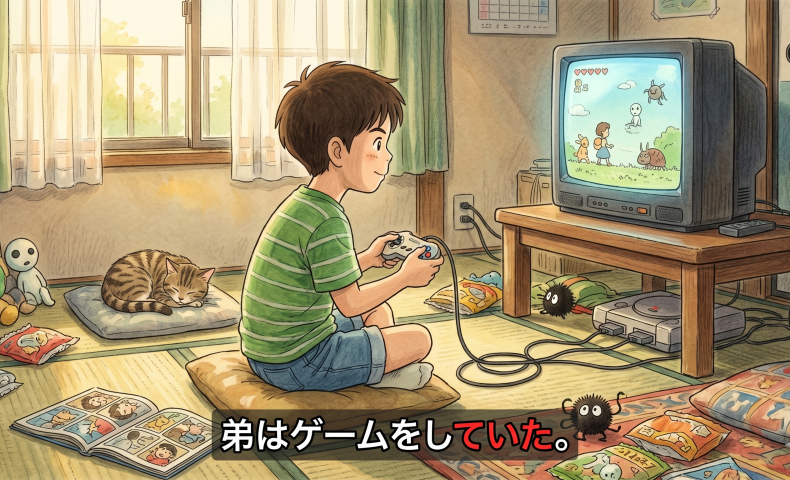
(2) 弟はゲームをしていた / していました。
(3) 家族はテレビを見ていた / 見ていました。
(4) 男の子は静かに座っていた / 座っていました。
(5) 女の子は公園で散歩をしていた / していました。
(6) 子供たちは外で遊んでいた / 遊んでいました。
ことばと表現 / Words & Expressions
歌【うた\ /Uta/】 song
座る【すわる ̄ /Suwaru/】 to sit
散歩【さんぽ ̄ /Sanpo/】 walk, stroll
遊ぶ【あそぶ ̄ /Asobu/】 to play
英語 / えいご / English
(1) My younger sister was singing a song.
(2) My younger brother was playing a game.
(3) My family was watching TV.
(4) The boy was sitting quietly.
(5) The girl was taking a walk in the park.
(6) The children were playing outside.
ひらがな / Hiragana
(1) いもうとはうたをうたっていた / うたっていました。
(2) おとうとはげーむをしていた / していました。
(3) かぞくはてれびをみていた / みていました。
(4) おとこのこはしずかにすわっていた / すわっていました。
(5) おんなのこはこうえんでさんぽをしていた / していました。
(6) こどもたちはそとであそんでいた / あそんでいました。
ローマ字 / Roman characters
(1) Imōto wa uta o utatte ita / utatte imashita.
(2) Otōto wa gēmu o shite ita / shite imashita.
(3) Kazoku wa terebi o mite ita / mite imashita.
(4) Otoko no ko wa shizuka ni suwatte ita / suwatte imashita.
(5) Onna no ko wa kōen de sanpo o shite ita / shite imashita.
(6) Kodomotachi wa soto de asonde ita / asonde imashita.













No comments yet.