
Meaning:
「〜さ」 turns adjectives into nouns that express **degree**, **quality**, or **extent**.
It corresponds to English “-ness”, “degree of ~”, “how ~ something is”.
Examples:
広い(ひろい) → 広さ(ひろさ)(width / spaciousness)
甘い(あまい) → 甘さ(あまさ)(sweetness)
便利(べんり) → 便利さ(べんりさ)(convenience)
Grammar Point:
Attach 「さ」 to:
– い‑adjectives(remove い → add さ)
– な‑adjectives(stem + さ)
Formation:
Adjective + さ
→ becomes a noun expressing degree/quality
日本語 / にほんご / Japanese
(1) この部屋の広さは十分だ / 十分です。
(2) このリンゴの甘さは最高だ / 最高です。
(3) このアプリの便利さは抜群だ / 抜群です。
(4) その包丁の鋭さは注意が必要だ / 必要です。
(5) 冬の空気の冷たさは厳しい / 厳しいです。
(6) その本の重さは1kgだ / 1kgです。
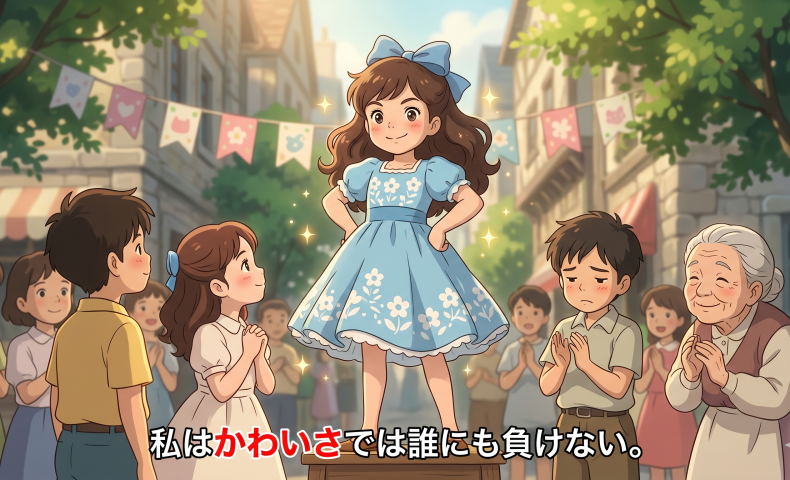
(7) 私はかわいさでは誰にも負けない / 負けません。
(8) 今年の暑さは普通ではない / 普通ではありません。
ことばと表現 / Words & Expressions
広さ【ひろ\さ /Hirosa/】 width, area, size
十分【じゅうぶん ̄ /Jūbun/】 enough, sufficient
甘さ【あま\さ /Amasa/】 sweetness
最高【さいこう ̄ /Saikō/】 the best, greatest
抜群【ばつぐん ̄ /Batsugun/】 outstanding, excellent
鋭さ【するど\さ /Surudosa/】 sharpness
注意【ちゅうい\ /Chūi/】 caution, attention
冷たさ【つめた\さ /Tsumetasa/】 coldness (to the touch)
厳しい【きびし\い /Kibishii/】 severe, strict, intense
重さ【おも\さ /Omosa/】 weight
負ける【まける ̄ /Makeru/】 to lose, to be defeated
暑さ【あつ\さ /Atsusa/】 heat (weather)
普通【ふつう ̄ /Futsū/】 normal, ordinary
英語 / えいご / English
(1) The size of this room is enough.
(2) The sweetness of this apple is the best.
(3) The convenience of this app is outstanding.
(4) The sharpness of that knife requires caution.
(5) The coldness of winter air is harsh.
(6) The weight of that book is 1 kg.
(7) When it comes to cuteness, I lose to no one.
(8) This year’s heat is not normal.
ひらがな / Hiragana
(1) このへやのひろさはじゅうぶんだ / じゅうぶんです。
(2) このりんごのあまさはさいこうだ / さいこうです。
(3) このあぷりのべんりさはばつぐんだ / ばつぐんです。
(4) そのほうちょうのするどさはちゅういがひつようだ / ひつようです。
(5) ふゆのくうきのつめたさはきびしい / きびしいです。
(6) そのほんのおもさはいちキロだ / いちキロです。
(7) わたしはかわいさではだれにもまけない / まけません。
(8) ことしのあつさはふつうではない / ふつうではありません。
ローマ字 / Roman characters
(1) Kono heya no hirosa wa jūbun da / jūbun desu.
(2) Kono ringo no amasa wa saikō da / saikō desu.
(3) Kono apuri no benrisa wa batsugun da / batsugun desu.
(4) Sono hōchō no surudosa wa chūi ga hitsuyō da / hitsuyō desu.
(5) Fuyu no kūki no tsumetasa wa kibishii / kibishii desu.
(6) Sono hon no omosa wa ichi‑kiro da / ichi‑kiro desu.
(7) Watashi wa kawaisa de wa dare ni mo makenai / makemasen.
(8) Kotoshi no atsusa wa futsū de wa nai / futsū de wa arimasen.






No comments yet.