
Meaning:
Used to express doing one action *without* doing another action.
Means “without doing A, (someone) does B.”
Grammar Point:
Attach 「ないで」 to the negative form of a verb.
Indicates that the first action is skipped or not performed.
Formation:
Verb(negative form)+ ないで + Action
日本語 / にほんご / Japanese
(1) 妹は運動しないでテレビを見る / 見ます。
(2) 母は買い物をしないで帰る / 帰ります。
(3) 今週末、私は外出しないで家にいる / います。
(4) 兄は鍵をかけないで家を出た / 出ました。
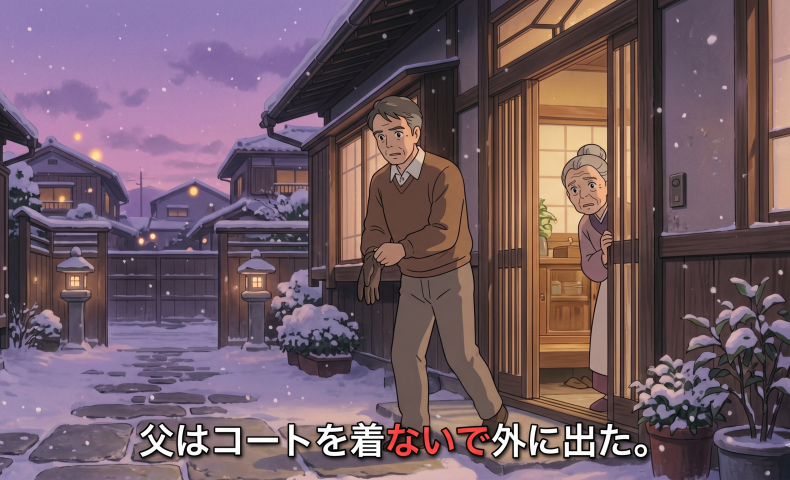
(5) 父はコートを着ないで外に出た / 出ました。
(6) 兄は朝ご飯を食べないで学校に行った / 行きました。
ことばと表現 / Words & Expressions
運動【うんどう ̄ /Undō/】 exercise
外出【がいしゅつ ̄ /Gaishutsu/】 going out
鍵【かぎ\ /Kagi/】 key
かける【かえ\る /Kakeru/】 to lock (a door)
コート【こ\ーと /Kōto/】 coat
英語 / えいご / English
(1) My younger sister watches TV without exercising.
(2) My mother goes home without shopping.
(3) This weekend, I will stay home without going out.
(4) My older brother left the house without locking the door.
(5) My father went outside without wearing a coat.
(6) My older brother went to school without eating breakfast.
ひらがな / Hiragana
(1) いもうとはうんどうしないでてれびをみる / みます。
(2) はははかいものをしないでかえる / かえります。
(3) こんしゅうまつ、わたしはがいしゅつしないでいえにいる / います。
(4) あにはかぎをかけないでいえをでた / でました。
(5) ちちはこーとをきないでそとにでた / でました。
(6) あにはあさごはんをたべないでがっこうにいった / いきました。
ローマ字 / Roman characters
(1) Imōto wa undō shinai de terebi o miru / mimasu.
(2) Haha wa kaimono o shinai de kaeru / kaerimasu.
(3) Konshūmatsu, watashi wa gaishutsu shinai de ie ni iru / imasu.
(4) Ani wa kagi o kakenai de ie o deta / demashita.
(5) Chichi wa kōto o kinai de soto ni deta / demashita.
(6) Ani wa asagohan o tabenai de gakkō ni itta / ikimashita.




No comments yet.