
謙譲語(けんじょうご/kenjougo) is the language used to show humility when you speak about yourself. In this case, you’ll only use 謙譲語 when speaking about yourself or those in your “inner circle,” such as close family or friends. Of course, you would never use 謙譲語 when talking about others, especially if they’re in a higher social position than you.
Meaning
– 存じます(ぞんじます):I think / I believe(humble)
– 存じています(ぞんじます):I know(humble)
– 伺いました(うかがいました):I heard(humble)
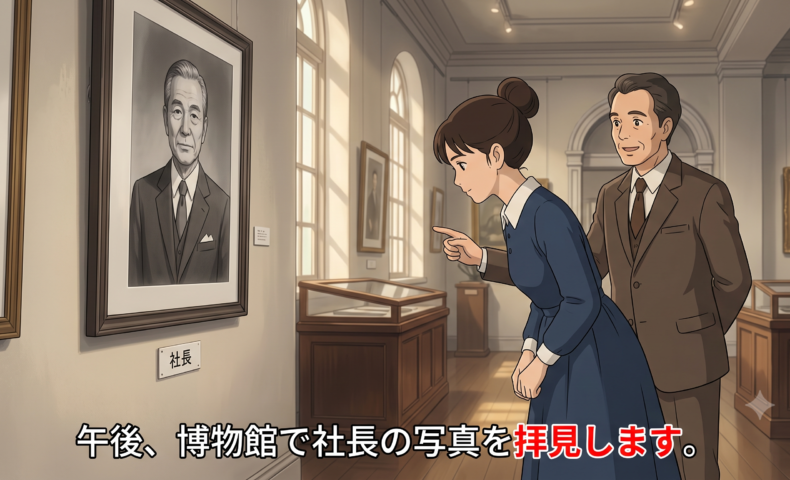
– 拝見します(はいけんします):I will see / look at(humble)
Grammar Point
These forms are **humble expressions(謙譲語)** used when the speaker lowers themselves to show respect to the listener or the person involved.
● **思います → 存じます(humble)**
Used when expressing one’s own thoughts politely.
● **知っています → 存じています(humble)**
Used when referring to one’s own knowledge politely.
● **聞きました → 伺いました(humble)**
Used when reporting something you heard politely.
● **見ます → 拝見します(humble)**
Used when you will look at or see something belonging to someone higher.
Formation
Plain → Humble
思います → 存じます
知っています → 存じています
聞きました → 伺いました
見ます → 拝見します
日本語 / にほんご / Japanese
(1) 週末、道は混むと思います / 存じます。
(2) 社長はすでに出発されたと思います / 存じます。
(3) 昔から先生の名前を知っています / 存じています。
(4) その建物の名前を知っています / 存じています。
(5) 課長が新しい仕事を始めると聞きました / 伺いました。
(6) 今日、社長は外出していると聞きました / 伺いました。
(7) 明日、美術館で先生の絵を見ます / 拝見します。
(8) 午後、博物館で社長の写真を見ます / 拝見します。
ことばと表現 / Words & Expressions
混む【こ\む /Komu/】 to get crowded
出発する【しゅっぱつする ̄ /Shuppatsu suru/】 to depart
建物【たてもの ̄ /Tatemono/】 building
伺う【うかがう ̄ /Ukagau/】 to hear ask (humble)
拝見する【はいけんする ̄ /Haiken suru/】 to see look (humble)
博物館【はくぶつかん ̄ /Hakubutsukan/】 museum
英語 / えいご / English
(1) I think the roads will be crowded this weekend.
(2) I think the president has already departed.
(3) I have known the teacher’s name for a long time.
(4) I know the name of that building.
(5) I heard that the section chief will start a new job.
(6) I heard that the president is out today.
(7) Tomorrow, I will see the teacher’s painting at the museum.
(8) This afternoon, I will see the president’s photo at the museum.
ひらがな / Hiragana
(1) しゅうまつ、みちはこむとおもいます / ぞんじます。
(2) しゃちょうはすでにしゅっぱつされたとおもいます / ぞんじます。
(3) むかしからせんせいのなまえをしっています / ぞんじています。
(4) そのたてもののなまえをしっています / ぞんじています。
(5) かちょうがあたらしいしごとをはじめるとききました / うかがいました。
(6) きょう、しゃちょうはがいしゅつしているとききました / うかがいました。
(7) あした、びじゅつかんでせんせいのえをみます / はいけんします。
(8) ごご、はくぶつかんでしゃちょうのしゃしんをみます / はいけんします。
ローマ字 / Roman characters
(1) Shūmatsu, michi wa komu to omoimasu / zonjimasu.
(2) Shachō wa sude ni shuppatsu sareta to omoimasu / zonjimasu.
(3) Mukashi kara sensei no namae o shitte imasu / zonjite imasu.
(4) Sono tatemono no namae o shitte imasu / zonjite imasu.
(5) Kachō ga atarashii shigoto o hajimeru to kikimashita / ukagaimashita.
(6) Kyō, shachō wa gaishutsu shite iru to kikimashita / ukagaimashita.
(7) Ashita, bijutsukan de sensei no e o mimasu / haiken shimasu.
(8) Gogo, hakubutsukan de shachō no shashin o mimasu / haiken shimasu.




No comments yet.