
Meaning
to give something to someone (from the speaker or someone close to the speaker)
Grammar Point
Japanese has two verbs for giving.
「あげる」 is the Japanese word for “to give” seen from the speaker’s point of view. You must use this verb when you are giving something or doing something for someone else.
あげる -> I give to you, you give to others, I give to others, somebody gives to somebody else
くれる -> Somebody gives me, you give me, somebody gives you
Nuance:
– Used when the giver is the speaker or someone psychologically close to the speaker.
– When giving to someone socially higher, the humble form **さしあげる** is used.
– When the receiver is the speaker, **くれる** is used instead.
Formation
Person + は + Person/Animal/Plant + に + Noun + を + あげる
Person + は + Person + に + Noun + を + あげた(past)
日本語 / にほんご / Japanese
(1) 私は妹に人形をあげる / あげます。
(2) 兄は鳥に餌をあげる / あげます。
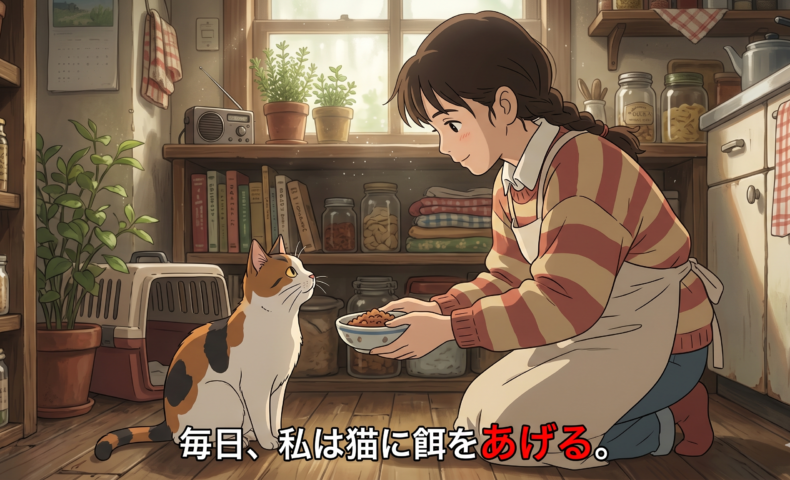
(3) 毎日、私は猫に餌をあげる / あげます。
(4) 毎週、私は事務所の木に水をあげる / あげます。
(5) 先月、兄は母に花をあげた / あげました。
(6) 先月、父は母に指輪をあげた / あげました。
(7) 今月、私は友達にお土産をあげた / あげました。
(8) 誕生日に弟は子供におもちゃをあげた / あげました。
ことばと表現 / Words & Expressions
人形【にんぎょう ̄ /Ningyō/】 doll
餌【え\さ /Esa/】 feed food (for animals)
事務所【じむしょ ̄ /Jimusho/】 office
指輪【ゆびわ ̄ /Yubiwa/】 ring
お土産【おみやげ ̄ /Omiyage/】 souvenir gift
おもちゃ【おも\ちゃ /Omocha/】 toy
英語 / えいご / English
(1) I give a doll to my younger sister.
(2) My older brother gives food to the bird.
(3) Every day, I give food to my cat.
(4) Every week, I give water to the office tree.
(5) Last month, my older brother gave flowers to our mother.
(6) Last month, my father gave a ring to my mother.
(7) This month, I gave a souvenir to my friend.
(8) On his birthday, my younger brother gave a toy to a child.
ひらがな / Hiragana
(1) わたしはいもうとににんぎょうをあげる / あげます。
(2) あにはとりにえさをあげる / あげます。
(3) まいにち、わたしはねこにえさをあげる / あげます。
(4) まいしゅう、わたしはじむしょのきにみずをあげる / あげます。
(5) せんげつ、あにはははにはなをあげた / あげました。
(6) せんげつ、ちちはははにゆびわをあげた / あげました。
(7) こんげつ、わたしはともだちにおみやげをあげた / あげました。
(8) たんじょうびにおとうとはこどもにおもちゃをあげた / あげました。
ローマ字 / Roman characters
(1) Watashi wa imōto ni ningyō o ageru / agemasu.
(2) Ani wa tori ni esa o ageru / agemasu.
(3) Mainichi, watashi wa neko ni esa o ageru / agemasu.
(4) Maishū, watashi wa jimusho no ki ni mizu o ageru / agemasu.
(5) Sengetsu, ani wa haha ni hana o ageta / agemashita.
(6) Sengetsu, chichi wa haha ni yubiwa o ageta / agemashita.
(7) Kongetsu, watashi wa tomodachi ni omiyage o ageta / agemashita.
(8) Tanjōbi ni otōto wa kodomo ni omocha o ageta / agemashita.






No comments yet.