
Meaning
to have someone do something for you / to receive a favor
Grammar Point
「〜てもらう」 is a **transitive construction** meaning that the subject **receives a helpful action** from someone.
The receiver is the subject, and the giver performs the action.
Structure:
**Receiver + は/が + Giver + に + Verb-て + もらう**
Nuance:
– Focuses on **the benefit to the receiver**.
– Often expresses help, support, or gratitude.
– When the giver is socially higher, the humble form **〜ていただく** is used instead.
Formation
Person + は + Person + に + Verb-て + もらう
日本語 / にほんご / Japanese
(1) 学生は友達に荷物を運んでもらう / 運んでもらいます。
(2) 弟は店員に商品を探してもらう / 探してもらいます。
(3) 私は店員に商品を説明してもらう / 説明してもらいます。
(4) 夫は店員に商品を包んでもらう / 包んでもらいます。
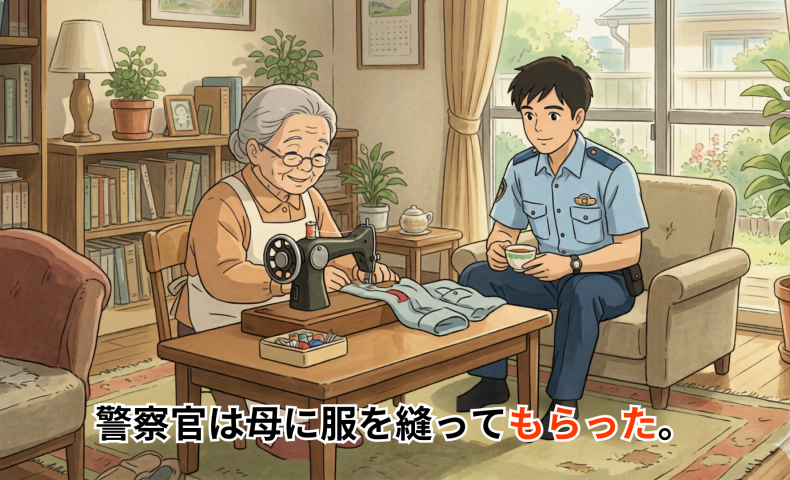
(5) 警察官は母に服を縫ってもらった / 縫ってもらいました。
(6) 妹は運転手に写真を撮ってもらった / 撮ってもらいました。
(7) 私は先生に日本語を直してもらった / 直してもらいました。
(8) 銀行員は社長にパーティーで挨拶をしてもらった / 挨拶してもらいました。
ことばと表現 / Words & Expressions
荷物【に\もつ /Nimotsu/】 luggage baggage
運ぶ【はこぶ ̄ /Hakobu/】 to carry transport
店員【てんいん ̄ /Ten’in/】 store clerk
商品【しょうひん ̄ /Shōhin/】 product goods
説明する【せつめいする ̄ /Setsumei suru/】 to explain
包む【つつ\む /Tsutsumu/】 to wrap
警察官【けいさつか\ん /Keisatsukan/】 police officer
縫う【ぬ\う /Nū/】 to sew
運転手【うんて\んしゅ /Untenshu/】 driver
撮る【と\る /Toru/】 to take (a photo)
直す【なお\す /Naosu/】 to fix correct
挨拶する【あいさつする ̄ /Aisatsu suru/】 to greet
英語 / えいご / English
(1) The student has a friend carry the luggage for him.
(2) My younger brother has a store clerk look for a product.
(3) I have a store clerk explain the product to me.
(4) My husband has a store clerk wrap the product.
(5) The police officer had his mother sew clothes for him.
(6) My younger sister had a driver take a photo for her.
(7) I had my teacher correct my Japanese.
(8) The bank employee had the company president give a greeting at the party.
ひらがな / Hiragana
(1) がくせいはともだちににもつをはこんでもらう / はこんでもらいます。
(2) おとうとはてんいんにしょうひんをさがしてもらう / さがしてもらいます。
(3) わたしはてんいんにしょうひんをせつめいしてもらう / せつめいしてもらいます。
(4) おっとはてんいんにしょうひんをつつんでもらう / つつんでもらいます。
(5) けいさつかんはははにふくをぬってもらった / ぬってもらいました。
(6) いもうとはうんてんしゅにしゃしんをとってもらった / とってもらいました。
(7) わたしはせんせいににほんごをなおしてもらった / なおしてもらいました。
(8) ぎんこういんはしゃちょうにパーティーであいさつをしてもらった / あいさつしてもらいました。
ローマ字 / Roman characters
(1) Gakusei wa tomodachi ni nimotsu o hakonde morau / hakonde moraimasu.
(2) Otōto wa ten’in ni shōhin o sagashite morau / sagashite moraimasu.
(3) Watashi wa ten’in ni shōhin o setsumei shite morau / setsumei shite moraimasu.
(4) Otto wa ten’in ni shōhin o tsutsunde morau / tsutsunde moraimasu.
(5) Keisatsukan wa haha ni fuku o nutte moratta / nutte moraimashita.
(6) Imōto wa untenshu ni shashin o totte moratta / totte moraimashita.
(7) Watashi wa sensei ni Nihongo o naoshite moratta / naoshite moraimashita.
(8) Ginkōin wa shachō ni pātī de aisatsu o shite moratta / aisatsu shite moraimashita.








No comments yet.