
Meaning:
「〜たら」 expresses a **conditional** meaning:
– **when** (temporal condition)
– **if** (hypothetical condition)
It is used when one action happens **after** another, or when a condition is met.
English equivalents:
“when…”, “after…”, “if…”
Grammar Point:
Verb (past tense) + ら
い‑adjective(かった)+ ら
な‑adjective / noun + だったら
Formation:
A たら、B
→ “When/If A, B”
日本語 / にほんご / Japanese
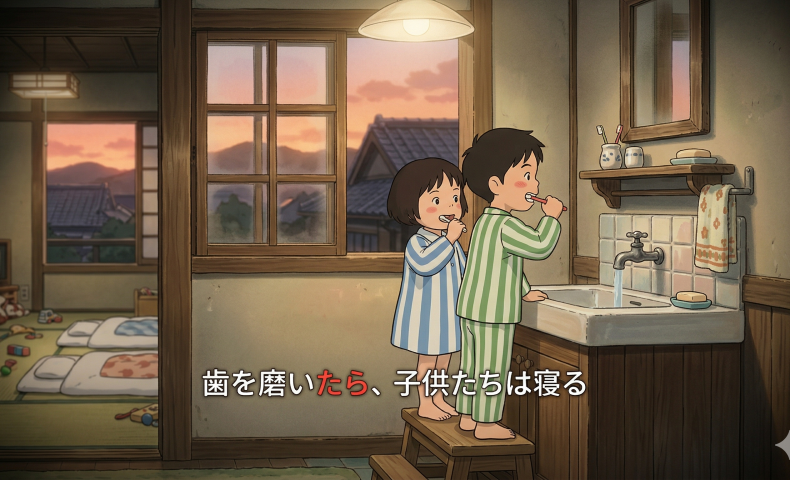
(1) 歯を磨いたら、子供たちは寝る / 寝ます。
(2) 本を読んだら、兄はメモを取る / メモを取ります。
(3) 冬だったら、家族はスキーをする / スキーをします。
(4) 土曜日だったら、母は買い物をする / 買い物をします。
(5) 近かったら、私は歩く / 歩きます。
(6) 遠かったら、私たちはバスに乗る / 乗ります。
(7) 便利だったら、そのアプリを使う / 使います。
(8) 大変だったら、あなたを手伝う / 手伝います。
ことばと表現 / Words & Expressions
歯【は\ /Ha/】 tooth
磨く【みがく ̄ /Migaku/】 to brush, to polish
子供【こども ̄ /Kodomo/】 child
メモ【メ\モ /Memo/】 memo, note
取る【と\る /Toru/】 to take
冬【ふゆ\ /Fuyu/】 winter
スキー【ス\キー /Sukī/】 skiing
近い【ちか\い /Chikai/】 near
遠い【とおい ̄ /Tōi/】 far
便利【べんり\ /Benri/】 convenient
アプリ【ア\プリ /Apuri/】 app
大変【たいへん ̄ /Taihen/】 tough, hard
英語 / えいご / English
(1) When they brush their teeth, the children go to bed.
(2) When he reads a book, my older brother takes notes.
(3) If it is winter, my family goes skiing.
(4) If it is Saturday, my mother goes shopping.
(5) If it is close, I will walk.
(6) If it is far, we will take the bus.
(7) If it is convenient, I will use that app.
(8) If it is difficult, I will help you.
ひらがな / Hiragana
(1) はをみがいたら、こどもたちはねる / ねます。
(2) ほんをよんだら、あにはめもをとる / めもをとります。
(3) ふゆだったら、かぞくはすきーをする / すきーをします。
(4) どようびだったら、はははかいものをする / かいものをします。
(5) ちかかったら、わたしはあるく / あるきます。
(6) とおかったら、わたしたちはばすにのる / のります。
(7) べんりだったら、そのあぷりをつかう / つかいます。
(8) たいへんだったら、あなたをてつだう / てつだいます。
ローマ字 / Roman characters
(1) Ha o migaitara, kodomotachi wa neru / nemasu.
(2) Hon o yondara, ani wa memo o toru / torimasu.
(3) Fuyu dattara, kazoku wa sukī o suru / sukī o shimasu.
(4) Doyōbi dattara, haha wa kaimono o suru / kaimono o shimasu.
(5) Chikakattara, watashi wa aruku / arukimasu.
(6) Tōkattara, watashitachi wa basu ni noru / norimasu.
(7) Benri dattara, sono apuri o tsukau / tsukaimasu.
(8) Taihen dattara, anata o tetsudau / tetsudaimasu.
Contents
~tara (たら) vs. ~nara (なら)
In Japanese, both ~tara and ~nara translate to “if” in English, but they are used in different contexts based on timing and the speaker’s intent.
1. ~tara (たら)
Key Concept: “After A happens, B occurs”
~tara is the most versatile conditional. It focuses on a sequence of events where Condition A must be completed before Result B can happen.
- Hypothetical “If”: Used for “if” situations that may or may not happen.
- Ame ga futtara, ikimasen. (If it rains, I won’t go.)
- Temporal “When/Once”: Used for things that will definitely happen in the future.
- Ie ni tsuitara, denwa shite kudasai. (Once/When you arrive home, please call me.)
- Structure: Past tense form + ra.
- Taberu → Tabeta → Tabetara
2. ~nara (なら)
Key Concept: “If that is the case” / “Speaking of…”
~nara is used to provide advice, suggestions, or opinions based on information provided by the listener or the current context. Unlike ~tara, the timing of the result can happen before the condition.
- Contextual “If”: Used when the speaker picks up a topic mentioned by someone else.
- Person A: “I want to buy a camera.”
- Person B: Kamera o kau nara, Akihabara ga ii desu yo. (If you are going to buy a camera [if that is what you want], Akihabara is good.)
- No Time Sequence: The action in the second part often happens before or at the same time as the first part.
- Nihon ni iku nara, pasu-poto ga hitsuyo desu. (If you are going to Japan, you need a passport.) Note: You need the passport before you go.
- Structure: Dictionary form + nara.
- Iku → Iku nara
Key Differences Comparison
| Feature | ~tara (たら) | ~nara (なら) |
|---|---|---|
| Focus | Sequence (A then B) | Context/Information |
| Time Order | A must finish first | B can happen before A |
| Main Use | General “if,” “when,” “once” | Advice, suggestions, “If it’s X…” |
| Example | Atsukattara, mado o akete. (If/When it gets hot, open the window.) | Atsui nara, mado o akete. (If [you say] it’s hot, open the window.) |
Summary Rule of Thumb
- Use ~tara when you want to say “If/When A happens, then B.”
- Use ~nara when you want to say “If what you said is true/If that is the topic, then B.”















No comments yet.