
Meaning:
Used to express the speaker’s wondering, uncertainty, or mild curiosity.
Often used by women, but men may use it in inner monologue or soft expressions.
Grammar Point:
「〜かしら」 attaches to the plain form of verbs, adjectives, and nouns.
It expresses internal questioning such as “I wonder…” or “Maybe…”.
Softer and more feminine than 「〜かな」.
Formation:
Verb(plain form)+ かしら
Noun + かしら
い-adjective + かしら
な-adjective + かしら
日本語 / にほんご / Japanese
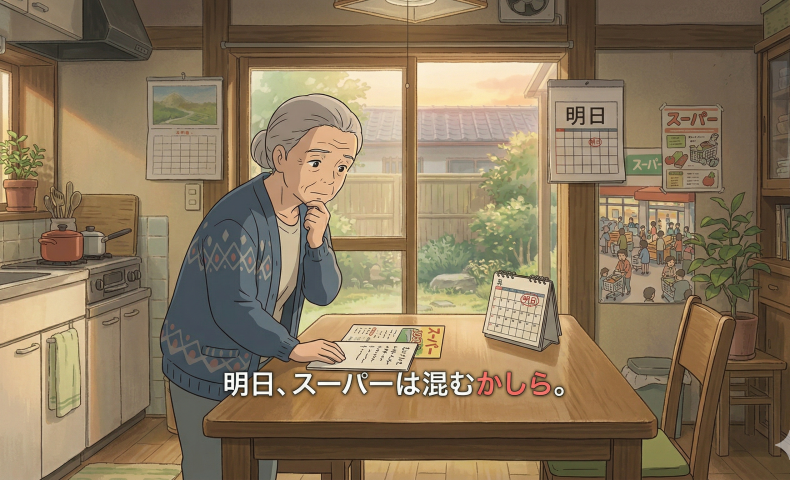
(1) 明日、スーパーは混むかしら。
(2) 彼の兄はどんなスポーツをするかしら。
(3) その果物は甘いかしら。
(4) 明日の天気は暑いかしら。
(5) あの映画は怖いかしら。
(6) あの建物は学校かしら。
(7) 今日は私の弟の誕生日かしら。
ことばと表現 / Words & Expressions
混む【こむ\ /Komu/】to get crowded
スポーツ【すぽーつ\ /Supōtsu/】sports
怖い【こわい\ /Kowai/】scary
建物【たてもの ̄ /Tatemono/】building
誕生日【たんじょうび\ /Tanjōbi/】birthday
英語 / えいご / English
(1) I wonder if the supermarket will be crowded tomorrow.
(2) I wonder what kind of sports his older brother plays.
(3) I wonder if that fruit is sweet.
(4) I wonder if tomorrow’s weather will be hot.
(5) I wonder if that movie is scary.
(6) I wonder if that building is a school.
(7) I wonder if today is my younger brother’s birthday.
ひらがな / Hiragana
(1) あした、すーぱーはこむかしら。
(2) かれのあにはどんなすぽーつをするかしら。
(3) そのくだものはあまいかしら。
(4) あしたのてんきはあついかしら。
(5) あのえいがはこわいかしら。
(6) あのたてものはがっこうかしら。
(7) きょうはわたしのおとうとのたんじょうびかしら。
ローマ字 / Roman characters
(1) Ashita, sūpā wa komu kashira.
(2) Kare no ani wa donna supōtsu o suru kashira.
(3) Sono kudamono wa amai kashira.
(4) Ashita no tenki wa atsui kashira.
(5) Ano eiga wa kowai kashira.
(6) Ano tatemono wa gakkō kashira.
(7) Kyō wa watashi no otōto no tanjōbi kashira.








No comments yet.