
Meaning
見える(みえる):to be visible / can be seen naturally
見られる(みられる):to be able to see / can see (because conditions allow it)
Grammar Point
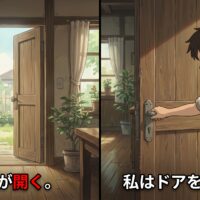
「見える」 is an **intransitive verb (自動詞 / intransitive)**.
It describes something that **is visible naturally**, without intention or effort.
The thing that is visible becomes the subject.
「見られる」 is the **potential form of 見る**, which is a **transitive verb (他動詞 / transitive)**.
It means **“can see”** because the situation or conditions make it possible.
It implies ability or opportunity, not natural visibility.
In short:
– **見える (intransitive)** = something *is visible* naturally
– **見られる (potential of 見る / transitive)** = someone *can see* something because conditions allow it
Formation
Visible object + が + 見える(intransitive)
Person + は/が + object + が + 見られる(potential / transitive)
日本語 / にほんご / Japanese
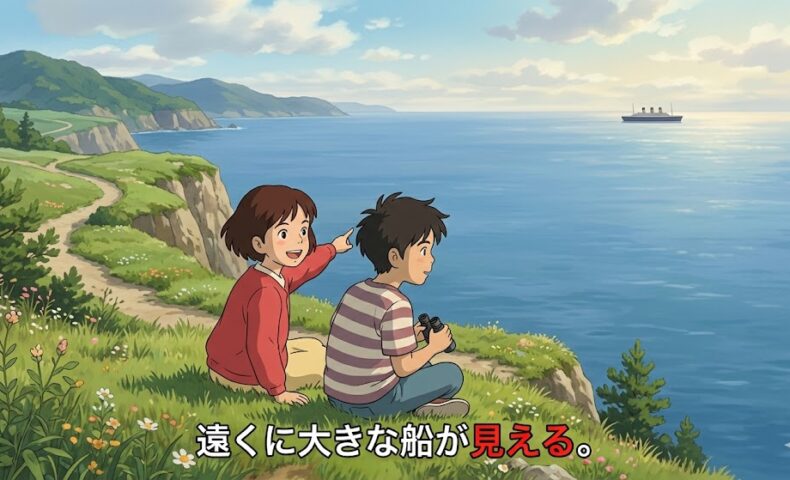
(1) 遠くに大きな船が見える / 見えます。
(2) 私たちの部屋の窓から青い海が見える / 見えます。
(3) そこから私たちは星が見える / 見えます。
(4) 夜、ここから花火が見られる / 見られます。
(5) 今週、あの美術館で有名な絵が見られる / 見られます。
(6) 来月、あの場所でサッカーの試合が見られる / 見られます。
ことばと表現 / Words & Expressions
遠く【とおく ̄ /Tōku/】 far away
船【ふ\ね /Fune/】 ship boat
窓【ま\ど /Mado/】 window
海【う\み /Umi/】 sea ocean
星【ほし ̄ /Hoshi/】 star
花火【は\なび /Hanabi/】 fireworks
美術館【びじゅつかん ̄ /Bijutsukan/】 art museum
有名【ゆうめい ̄ /Yūmei/】 famous
絵【え\ /E/】 painting picture
場所【ばしょ ̄ /Basho/】 place location
試合【しあい ̄ /Shiai/】 match game
英語 / えいご / English
(1) A large ship can be seen in the distance.
(2) We can see the blue sea from our room’s window.
(3) From there, we can see the stars.
(4) At night, fireworks can be seen from here.
(5) This week, a famous painting can be seen at that museum.
(6) Next month, a soccer match can be seen at that place.
ひらがな / Hiragana
(1) とおくにおおきなふねがみえる / みえます。
(2) わたしたちのへやのまどからあおいうみがみえる / みえます。
(3) そこからわたしたちはほしがみえる / みえます。
(4) よる、ここからはなびがみられる / みられます。
(5) こんしゅう、あのびじゅつかんでゆうめいなえがみられる / みられます。
(6) らいげつ、あのばしょでサッカーのしあいがみられる / みられます。
ローマ字 / Roman characters
(1) Tōku ni ōkina fune ga mieru / miemasu.
(2) Watashitachi no heya no mado kara aoi umi ga mieru / miemasu.
(3) Soko kara watashitachi wa hoshi ga mieru / miemasu.
(4) Yoru, koko kara hanabi ga mirareru / miraremasu.
(5) Konshū, ano bijutsukan de yūmei na e ga mirareru / miraremasu.
(6) Raigetsu, ano basho de sakkā no shiai ga mirareru / miraremasu.















No comments yet.