
Meaning:
Expresses that someone (other than the speaker) shows signs of a certain feeling or desire. Used to describe observable emotions or wants of others.
Grammar Point:
This pattern is used to express emotions, sensations, or desires that are observed in other people (third person).
Formation:
– い-adjective stem + がる/がります
– い-adjective stem + がっている/がっています
– 欲しい → 欲しがる/欲しがっている
日本語 / にほんご / Japanese
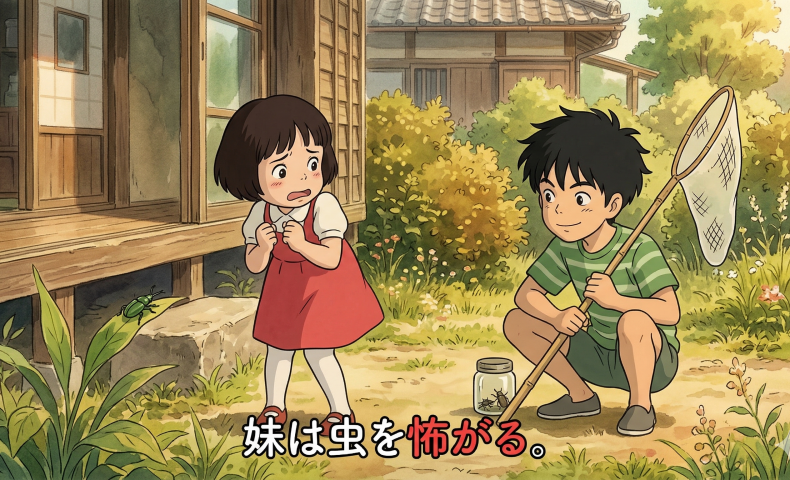
(1) 妹は虫を怖がる / 怖がります。
(2) 祖父は暑がる / 暑がります。
(3) 息子は恥ずかしがる / 恥ずかしがります。
(4) 彼女は寒がっている / 寒がっています。
(5) 猫は魚を欲しがっている / 欲しがっています。
(6) 子供はおもちゃを欲しがっている / 欲しがっています。
ことばと表現 / Words & Expressions
虫【むし\ /Mushi/】insect; bug
怖い【こわ\い /Kowai/】scary; afraid
祖父【そふ\ /Sofu/】grandfather
暑い【あつ ̄い /Atsui/】hot (weather)
息子【むすこ ̄ /Musuko/】son
恥ずかしい【はずか ̄しい /Hazukashii/】embarrassed; shy
寒い【さむ ̄い /Samui/】cold
欲しい【ほ ̄しい /Hoshii/】to want
子供【こ ̄ども /Kodomo/】child; children
おもちゃ【おも ̄ちゃ /Omocha/】toy
英語 / えいご / English
(1) My younger sister shows fear of insects.
(2) My grandfather shows signs of feeling hot.
(3) My son shows embarrassment.
(4) She is showing signs of being cold.
(5) The cat is showing desire for fish.
(6) The children are showing desire for toys.
ひらがな / Hiragana
(1) いもうとはむしをこわがる / こわがります。
(2) そふはあつがる / あつがります。
(3) むすこははずかしがる / はずかしがります。
(4) かのじょはさむがっている / さむがっています。
(5) ねこはさかなをほしがっている / ほしがっています。
(6) こどもはおもちゃをほしがっている / ほしがっています。
ローマ字 / Roman characters
(1) Imōto wa mushi wo kowagaru / Kowagarimasu.
(2) Sofu wa atsugaru / Atsugarimasu.
(3) Musuko wa hazukashigaru / Hazukashigarimasu.
(4) Kanojo wa samugatte iru / Samugatte imasu.
(5) Neko wa sakana wo hoshigatte iru / Hoshigatte imasu.
(6) Kodomo wa omocha wo hoshigatte iru / Hoshigatte imasu.
YouGlish / Pronunciation practice





No comments yet.