
Meaning:
「〜と」 expresses a natural result, automatic consequence, or something that always happens when a condition occurs.
It means “when…”, “whenever…”, or “if (and then)…”.
Grammar Point:
Used for:
– Natural phenomena
– Habitual results
– Instructions / directions
– Automatic consequences
Formation:
Verb (Dictionary form) + と
Noun + だ + と
い-Adjective (Dictionary form) + と
な-Adjective (Stem) + だ + と
日本語 / にほんご / Japanese
(1) 夜になると、外は暗くなる / 暗くなります。
(2) 空を見ると、星が見える / 見えます。
(3) 料理がおいしいと、みんな頼む / 頼みます。
(4) いつもより値段が高いと、誰も買わない / 買いません。
(5) 祭りだと、町に人が多くなる / 多くなります。
(6) 休日だと、私の家族は出かける / 出かけます。
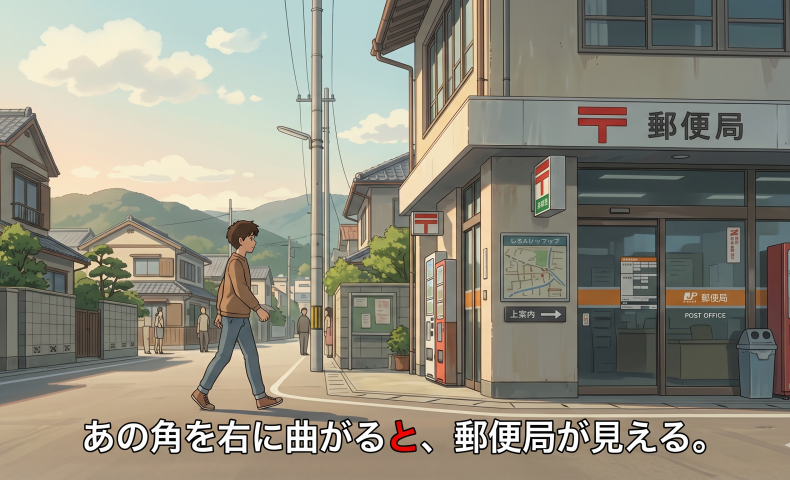
(7) あの角を右に曲がると、郵便局が見える / 見えます。
(8) この道をまっすぐ行くと、駅がある / あります。
ことばと表現 / Words & Expressions
暗い【くらい ̄ /Kurai/】 dark
星【ほし ̄ /Hoshi/】 star
頼む【たの\む /Tanomu/】 to order request
値段【ねだん ̄ /Nedan/】 price
祭り【まつり ̄ /Matsuri/】 festival
休日【きゅうじつ ̄ /Kyūjitsu/】 holiday
角【かど\ /Kado/】 corner
郵便局【ゆうびんきょく ̄ /Yūbinkyoku/】 post office
駅【え\き /Eki/】 station
英語 / えいご / English
(1) When it becomes night, it gets dark outside.
(2) When you look at the sky, you can see stars.
(3) When the food is delicious, everyone orders it.
(4) When the price is higher than usual, nobody buys it.
(5) When there is a festival, the town becomes crowded.
(6) When it’s a holiday, my family goes out.
(7) If you turn right at that corner, you can see the post office.
(8) If you go straight on this road, there is a station.
ひらがな / Hiragana
(1) よるになると、そとはくらくなる / くらくなります。
(2) そらをみると、ほしがみえる / みえます。
(3) りょうりがおいしいと、みんなたのむ / たのみます。
(4) いつもよりねだんがたかいと、だれもかわない / かいません。
(5) まつりだと、まちにひとがおおくなる / おおくなります。
(6) きゅうじつだと、わたしのかぞくはでかける / でかけます。
(7) あのかどをみぎにまがると、ゆうびんきょくがみえる / みえます。
(8) このみちをまっすぐいくと、えきがある / あります。
ローマ字 / Roman characters
(1) Yoru ni naru to, soto wa kuraku naru / kuraku narimasu.
(2) Sora o miru to, hoshi ga mieru / miemasu.
(3) Ryōri ga oishii to, minna tanomu / tanomimasu.
(4) Itsumo yori nedan ga takai to, dare mo kawanai / kaimasen.
(5) Matsuri da to, machi ni hito ga ōku naru / ōku narimasu.
(6) Kyūjitsu da to, watashi no kazoku wa dekakeru / dekakemasu.
(7) Ano kado o migi ni magaru to, yūbinkyoku ga mieru / miemasu.
(8) Kono michi o massugu iku to, eki ga aru / arimasu.





No comments yet.