
Meaning:
Used to express two actions happening at the same time.
Means “while doing A, (someone) does B.”
Grammar Point:
Attach 「ながら」 to the stem of a verb (ます-stem).
The action before 「ながら」 is the background action;
the action after it is the main action.
Formation:
Verb stem + ながら + Main action
日本語 / にほんご / Japanese
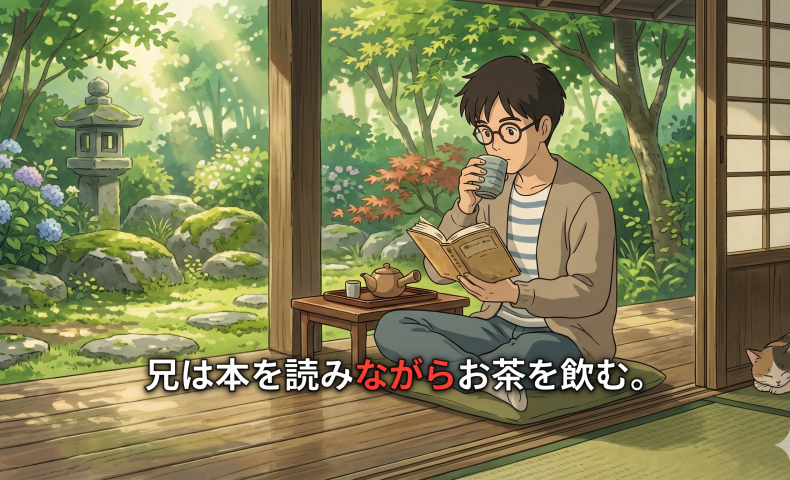
(1) 兄は本を読みながらお茶を飲む / 飲みます。
(2) 子供はゲームをしながらお菓子を食べる / 食べます。
(3) 妹は音楽を聞きながら勉強をする / 勉強します。
(4) 母は料理をしながら歌を歌う / 歌います。
(5) 姉は地図を見ながら道を教える / 教えます。
(6) 弟は電話をしながら公園を歩く / 歩きます。
ことばと表現 / Words & Expressions
お菓子【おかし ̄ /Okashi/】 sweets, snacks
地図【ちず\ /Chizu/】 map
教える【おしえ\る /Oshieru/】 to teach, to tell (directions)
英語 / えいご / English
(1) My older brother drinks tea while reading a book.
(2) The child eats snacks while playing games.
(3) My younger sister studies while listening to music.
(4) My mother sings while cooking.
(5) My older sister gives directions while looking at a map.
(6) My younger brother walks in the park while talking on the phone.
ひらがな / Hiragana
(1) あにはほんをよみながらおちゃをのむ / のみます。
(2) こどもはげーむをしながらおかしをたべる / たべます。
(3) いもうとはおんがくをききながらべんきょうをする / べんきょうします。
(4) はははりょうりをしながらうたをうたう / うたいます。
(5) あねはちずをみながらみちをおしえる / おしえます。
(6) おとうとはでんわをしながらこうえんをあるく / あるきます。
ローマ字 / Roman characters
(1) Ani wa hon o yominagara ocha o nomu / nomimasu.
(2) Kodomo wa gēmu o shinagara okashi o taberu / tabemasu.
(3) Imōto wa ongaku o kikinagara benkyō o suru / benkyō shimasu.
(4) Haha wa ryōri o shinagara uta o utau / utaimasu.
(5) Ane wa chizu o minagara michi o oshieru / oshiemasu.
(6) Otōto wa denwa o shinagara kōen o aruku / arukimasu.


No comments yet.