
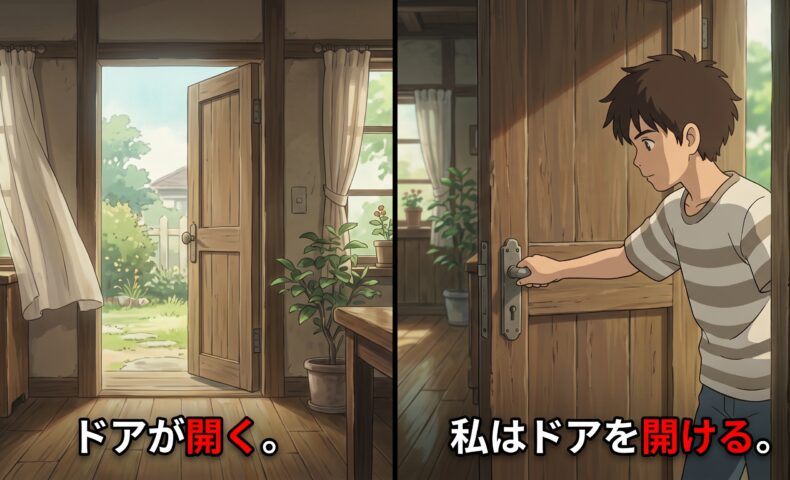
Meaning
Intransitive verbs (自動詞 じどうし jidoushi ): the subject does the action by itself
Transitive verbs (他動詞 たどうし tadoushi): the subject does the action to an object
Grammar Point
Japanese verbs are classified as intransitive(自動詞)or transitive(他動詞).
Intransitive verbs describe what happens to the subject and do not take a
direct object marked by「を」. Transitive verbs require a direct object
marked by「を」and describe an action done intentionally by the subject.
Formation
自動詞 (Intransitive): Subject + が + Intransitive Verb
他動詞 (Transitive): Subject + は/が + Object + を + Transitive Verb
| 自動詞 | 他動詞 |
| 開く(あく)to open | 開ける(あける)to open |
| 閉まる(しまる)to close | 閉める(しめる)to close |
| 消える(きえる)to go out | 消す(けす)to turn off |
| 出る(でる)to come out | 出す(だす)to take out |
日本語 / にほんご / Japanese
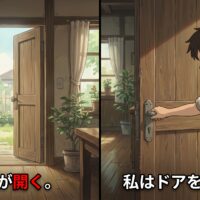
(1) ドアが開く / 開きます。
(2) 私はドアを開ける / 開けます。
(3) 窓が閉まる / 閉まります。
(4) 彼は窓を閉める / 閉めます。
(5) 電気が消える / 消えます。
(6) 私は電気を消す / 消します。
(7) 猫が家から出る / 出ます。
(8) 私は猫を家から出す / 出します。
ことばと表現 / Words & Expressions
– ドア【ドア ̄ /Doa/】door
– 開く【あく\ /Aku/】to open (intransitive)
– 開ける【あける\ /Akeru/】to open (transitive)
– 窓【まど\ /Mado/】window
– 閉まる【しまる\ /Shimaru/】to close (intransitive)
– 閉める【しめる\ /Shimeru/】to close (transitive)
– 電気【でんき\ /Denki/】light, electricity
– 消える【きえる\ /Kieru/】to go out, to disappear (intransitive)
– 消す【けす\ /Kesu/】to turn off, to erase (transitive)
– 猫【ねこ\ /Neko/】cat
– 出る【でる\ /Deru/】to come out, to leave (intransitive)
– 出す【だす\ /Dasu/】to take out, to put out (transitive)
英語 / えいご / English
(1) The door opens.
(2) I open the door.
(3) The window closes.
(4) He closes the window.
(5) The light goes out.
(6) I turn off the light.
(7) The cat comes out of the house.
(8) I let the cat out of the house.
ひらがな / Hiragana
(1) ドアがあく / あきます。
(2) わたしはドアをあける / あけます。
(3) まどがしまる / しまります。
(4) かれはまどをしめる / しめます。
(5) でんきがきえる / きえます。
(6) わたしはでんきをけす / けします。
(7) ねこがいえからでる / でます。
(8) わたしはねこをいえからだす / だします。
ローマ字 / Roman characters(ヘボン式)
(1) Doa ga aku / akimasu.
(2) Watashi wa doa o akeru / akemasu.
(3) Mado ga shimaru / shimarimasu.
(4) Kare wa mado o shimeru / shimemasu.
(5) Denki ga kieru / kiemasu.
(6) Watashi wa denki o kesu / keshimasu.
(7) Neko ga ie kara deru / demasu.
(8) Watashi wa neko o ie kara dasu / dashimasu.



No comments yet.