
Meaning
That is to say, in other words, namely
Grammar Point
「すなわち」is a formal conjunctive expression used to restate, clarify, or
paraphrase what was just said. It introduces an equivalent explanation or
definition of the preceding word or phrase. It is commonly used in written
Japanese and formal speech.
Formation:
すなわち + phrase
日本語 / にほんご / Japanese
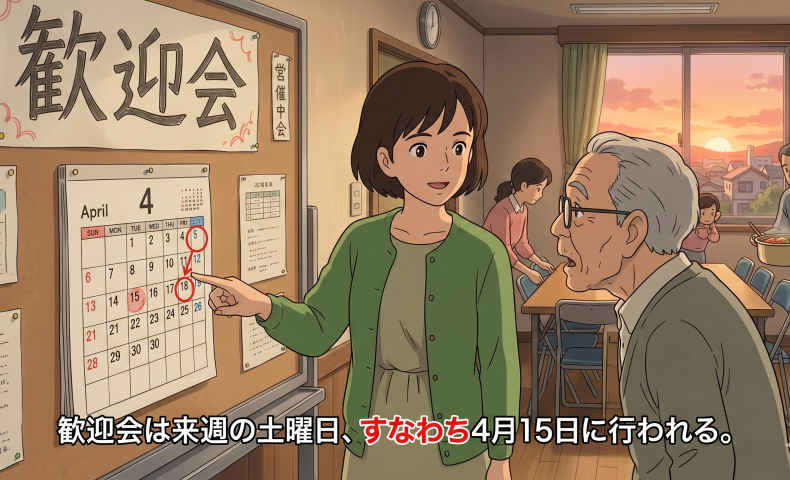
(1) 歓迎会は来週の土曜日、すなわち4月15日に行われる / 行われます。
(2) 彼は15年前、すなわち、19歳の時に東京へ来た / 来ました。
(3) 私は6年間、すなわち、36歳になるまで、大学で働いた / 働きました。
(4) 母の兄、すなわち、ぼくの伯父は病院で働いている / 働いています。
(5) 母の妹、すなわち、私の叔母はフクロウをペットとして飼っている / 飼っています。
(6) 叔母は天文学、すなわち星の科学を研究している / 研究をしています。
ことばと表現 / Words & Expressions
歓迎会【かんげいかい\ /Kangêkai/】welcome party
行われる【おこなわれる\ /Okonawareru/】to be held, to take place
伯父【おじ\ /Ozi/】uncle (mother’s older brother)
叔母【おば\ /Oba/】aunt (mother’s younger sister)
フクロウ【ふくろう\ /Hukurô/】owl
飼う【かう\ /Kau/】to keep (a pet), to raise (an animal)
天文学【てんもんがく\ /Tenmon gaku/】astronomy
研究する【けんきゅうする\ /Kenkyû suru/】to research, to study
英語 / えいご / English
(1) The welcome party will be held next Saturday, that is, on April 15th.
(2) He came to Tokyo 15 years ago, namely, when he was 19 years old.
(3) I worked at the university for six years, that is, until I turned 36.
(4) My mother’s older brother, namely my uncle, works at a hospital.
(5) My mother’s younger sister, that is, my aunt, keeps an owl as a pet.
(6) My aunt researches astronomy, in other words, the science of stars.
ひらがな / Hiragana
(1) かんげいかいは らいしゅうの どようび、すなわち しがつ じゅうごにちに おこなわれる / おこなわれます。
(2) かれは じゅうごねん まえ、すなわち、じゅうきゅう さいの ときに とうきょうへ きた / きました。
(3) わたしは ろくねんかん、すなわち、さんじゅうろくさいに なるまで、だいがくで はたらいた / はたらきました。
(4) ははの あに、すなわち、ぼくの おじは びょういんで はたらいている / はたらいています。
(5) ははの いもうと、すなわち、わたしの おばは フクロウを ペットとして かっている / かっています。
(6) おばは てんもんがく、すなわち ほしの かがくを けんきゅうを している / けんきゅうを しています。
ローマ字 / Roman letters
(1) Kangei-kai wa raishū no doyōbi, sunawachi shi gatsu juugo-nichi ni okonawa reru/ okonawa remasu.
(2) Kare wa jyuugo-nen mae, sunawachi, jyuukyu-sai no toki ni Tōkyō e kita/ kimashita.
(3) Watashi wa roku-nenkan, sunawachi, sannjyu oku-sai ni naru made, daigaku de hataraita/ hatarakimashita.
(4) Haha no ani, sunawachi, boku no oji wa byōin de hataraite iru/ hataraite imasu.
(5) Haha no imōto, sunawachi, watashi no oba wa fukurō o petto to shite katte iru/ katte imasu.
(6) Oba wa tenmongaku, sunawachi hoshi no kagaku o kenkyū shite iru/ kenkyū o shite imasu.





No comments yet.