
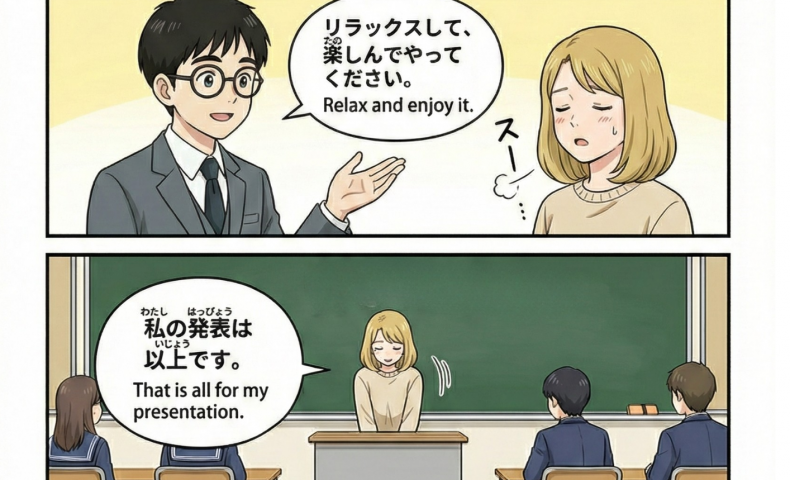
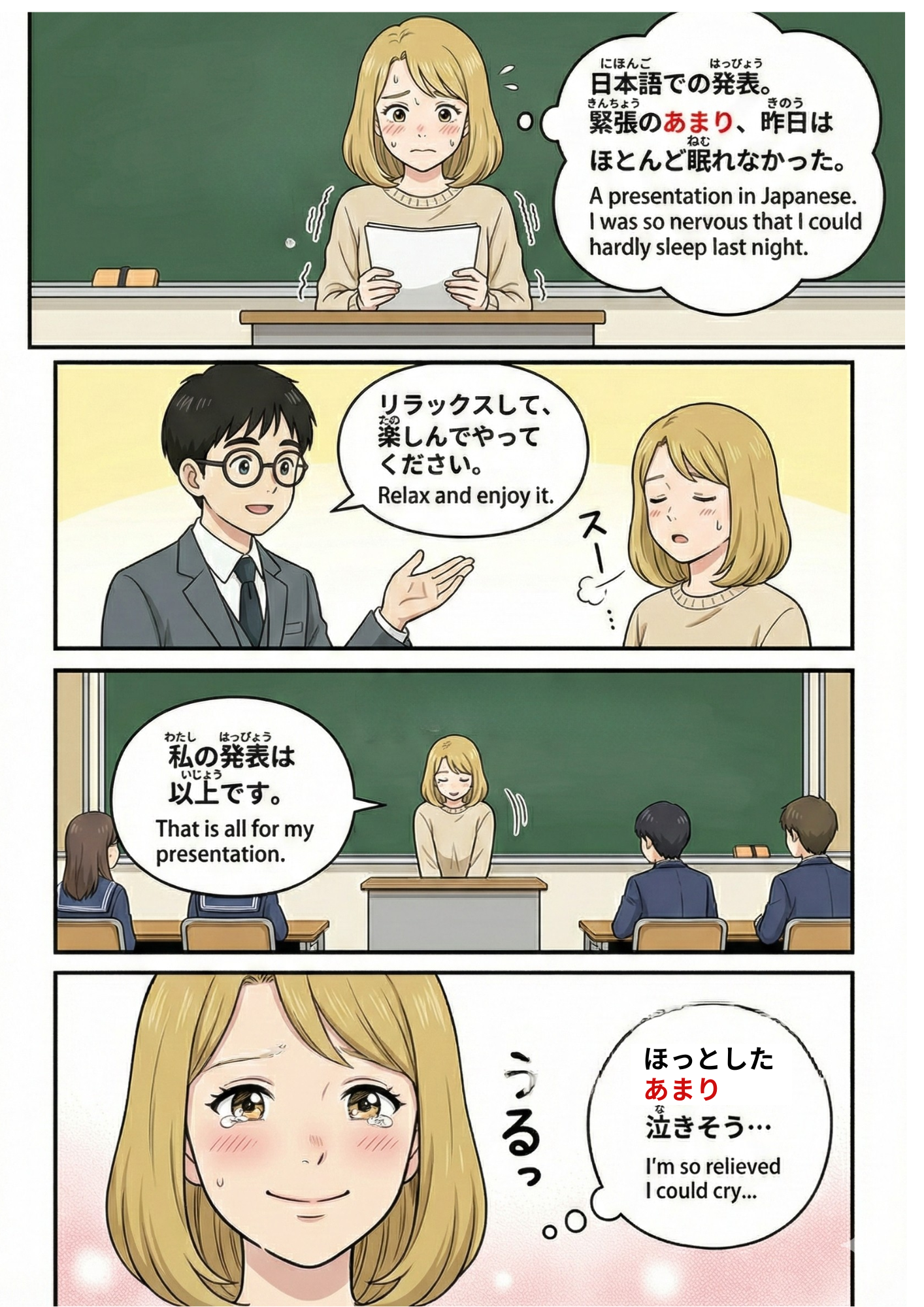
Meaning: so… that… / because of too much…
Grammar Point:
「〜あまり」is used to express that something happened as a result of an excessive emotion or action.
It can follow nouns (especially emotion-related), verb dictionary forms, or い/な-adjective stems.
Formation:
Verb-dictionary form + あまり
Verb-casual, past + あまり
Noun + のあまり
日本語 / にほんご / Japanese
(1) 不安のあまり、彼は眠れなかった / 眠れませんでした。
(2) 恐怖のあまり、彼女は声を出せなかった / 出せませんでした。
(3) 嬉しさのあまり、子供は走った / 走りました。
(4) 悲しさのあまり、姉は一日中部屋にいた / いました。
(5) 心配するあまり、母は眠れなかった / 眠れませんでした。
(6) 遊ぶあまり、子どもたちは時間を忘れてしまった。
(7) 急いでいたあまり、傘を忘れてしまった / 忘れてしまいました。
(8) 安かったあまり、同じ服を三着買った / 買いました。
ことばと表現 / Words & Expressions
不安【ふあん ̄ /Fuan/】anxiety; unease
眠る【ねむる ̄ /Nemuru/】to sleep
恐怖【きょうふ\ /Kyōfu/】fear
声【こ\え /Koe/】voice
出す【だ\す /Dasu/】to let out; to produce
嬉しい【うれし\い /Ureshii/】happy; glad
子供【こども ̄ /Kodomo/】child
走る【はし\る /Hashiru/】to run
悲しい【かなしい ̄ /Kanashii/】sad
姉【あね ̄ /Ane/】older sister
一日中【いちにちじゅう ̄ /Ichinichijū/】all day
心配する【しんぱいする ̄ /Shinpai suru/】to worry
遊ぶ【あそぶ ̄ /Asobu/】to play
忘れる【わすれる ̄ /Wasureru/】to forget
急ぐ【いそ\ぐ /Isogu/】to hurry
傘【か\さ /Kasa/】umbrella
同じ【おなじ ̄ /Onaji/】same
服【ふく\ /Fuku/】clothes
着【ちゃく\ /chaku/】counter for clothes
英語 / えいご / English
(1) He was so anxious that he couldn’t sleep.
(2) She was so scared that she couldn’t speak.
(3) The child ran out of happiness.
(4) My older sister stayed in her room all day out of sadness.
(5) My mother was so worried that she couldn’t sleep.
(6) The children played so much that they forgot the time.
(7) I was in such a hurry that I forgot my umbrella.
(8) It was so cheap that I bought three of the same shirt.
ひらがな / Hiragana
(1) ふあんのあまり、かれはねむれなかった / ねむれませんでした。
(2) きょうふのあまり、かのじょはこえをだせなかった / だせませんでした。
(3) うれしさのあまり、こどもははしった / はしりました。
(4) かなしさのあまり、あねはいちにちじゅうへやにいた / いました。
(5) しんぱいするあまり、はははねむれなかった / ねむれませんでした。
(6) あそぶあまり、こどもたちはじかんをわすれてしまった。
(7) いそいでいたあまり、かさをわすれてしまった / わすれてしまいました。
(8) やすかったあまり、おなじふくをさんちゃくかった / かいました。
ローマ字 / Roman characters
(1) Fuan no amari, kare wa nemurenakatta / nemuremasen deshita.
(2) Kyoufu no amari, kanojo wa koe o dasenakatta / dasemasen deshita.
(3) Ureshisa no amari, kodomo wa hashitta / hashirimashita.
(4) Kanashisa no amari, ane wa ichinichijū heya ni ita / imashita.
(5) Shinpai suru amari, haha wa nemurenakatta / nemuremasen deshita.
(6) Asobu amari, kodomotachi wa jikan o wasurete shimatta.
(7) Isoide ita amari, kasa o wasurete shimatta / wasurete shimaimashita.
(8) Yasukatta amari, onaji fuku o san-chaku katta / kaimashita.





No comments yet.