
Meaning
I think I will 〜 / I am planning to 〜 / I intend to 〜
Grammar Point
Used to express the speaker’s intention, decision, or plan.
「〜しようと思う」 indicates a personal will or a decision made at the moment of speaking or in the near future.
It is weaker and more flexible than 「〜つもりだ」 and often used for casual intentions.
Formation
Verb(volitional form)+ と思う
Verb(volitional form)+ と思っています(stronger, already decided)
日本語 / にほんご / Japanese
(1) 明日、私は水族館に行こうと思う / 行こうと思います。
(2) 今から私は銀行へ行こうと思う / 行こうと思います。
(3) 毎日、私は漢字を5つ覚えようと思う / 覚えようと思います。
(4) 今晩、私はこの本を読もうと思う / 読もうと思います。
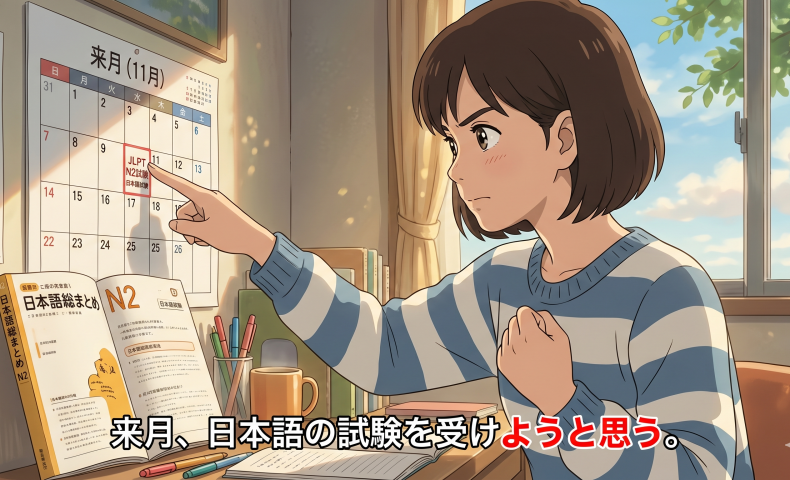
(5) 来月、日本語の試験を受けようと思う / 受けようと思います。
(6) 来年、私は自分で会社を作ろうと思う / 作ろうと思います。
(7) 来月、私は京都のホテルに泊まろうと思う / 泊まろうと思います。
(8) 仕事のあとで、私はもっと料理を練習しようと思う / 練習しようと思います。
ことばと表現 / Words & Expressions
水族館【すいぞくかん ̄ /Suizokukan/】 aquarium
銀行【ぎんこう ̄ /Ginkō/】 bank
試験【しけ\ん /Shiken/】 exam test
受ける【うけ\る /Ukeru/】 to take (an exam)
会社【かいしゃ ̄ /Kaisha/】 company
作る【つく\る /Tsukuru/】 to make create
泊まる【とまる ̄ /Tomaru/】 to stay (overnight)
料理【りょうり ̄ /Ryōri/】 cooking cuisine
練習する【れんしゅうする ̄ /Renshū suru/】 to practice
英語 / えいご / English
(1) I think I will go to the aquarium tomorrow.
(2) I think I will go to the bank now.
(3) I think I will memorize five kanji every day.
(4) I think I will read this book tonight.
(5) I think I will take the Japanese exam next month.
(6) I think I will start my own company next year.
(7) I think I will stay at a hotel in Kyoto next month.
(8) After work, I think I will practice cooking more.
ひらがな / Hiragana
(1) あした、わたしはすいぞくかんにいこうとおもう / いこうとおもいます。
(2) いまからわたしはぎんこうへいこうとおもう / いこうとおもいます。
(3) まいにち、わたしはかんじをいつつおぼえようとおもう / おぼえようとおもいます。
(4) こんばん、わたしはこのほんをよもうとおもう / よもうとおもいます。
(5) らいげつ、にほんごのしけんをうけようとおもう / うけようとおもいます。
(6) らいねん、わたしはじぶんでかいしゃをつくろうとおもう / つくろうとおもいます。
(7) らいげつ、わたしはきょうとのホテルにとまろうとおもう / とまろうとおもいます。
(8) しごとのあとで、わたしはもっとりょうりをれんしゅうしようとおもう / れんしゅうしようとおもいます。
ローマ字 / Roman characters
(1) Ashita, watashi wa suizokukan ni ikō to omou / ikō to omoimasu.
(2) Ima kara watashi wa ginkō e ikō to omou / ikō to omoimasu.
(3) Mainichi, watashi wa kanji o itsutsu oboeyō to omou / oboeyō to omoimasu.
(4) Konban, watashi wa kono hon o yomō to omou / yomō to omoimasu.
(5) Raigetsu, Nihongo no shiken o uke yō to omou / uke yō to omoimasu.
(6) Rainen, watashi wa jibun de kaisha o tsukurō to omou / tsukurō to omoimasu.
(7) Raigetsu, watashi wa Kyōto no hoteru ni tomarō to omou / tomarō to omoimasu.
(8) Shigoto no ato de, watashi wa motto ryōri o renshū shiyō to omou / renshū shiyō to omoimasu.




No comments yet.