
Meaning
I think that 〜 / I believe that 〜
Grammar Point
Used to express the speaker’s thoughts, opinions, or guesses.
Can be based on personal judgment, feelings, or observation.
Formation
Noun + だと思う
い-adjective + と思う
な-adjective + だと思う
Verb (plain form) + と思う
日本語 / にほんご / Japanese
(1) 私は電車が来ないと思う / 思います。
(2) 今、妹はテレビを見ていると思う / 思います。
(3) 私は外が寒いと思う / 思います。
(4) 週末のデパートは忙しいと思う / 思います。
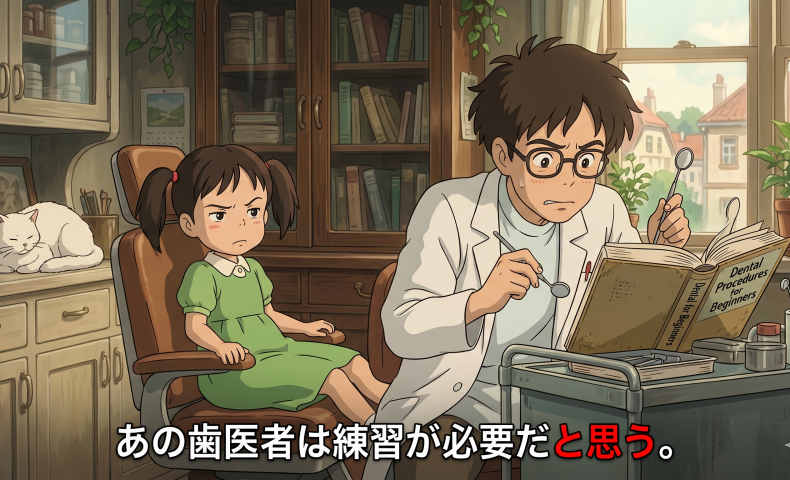
(5) あの歯医者は練習が必要だと思う / 思います。
(6) 彼女のカバンは丈夫だと思う / 思います。
(7) あの俳優はスポーツが得意だと思う / 思います。
(8) 明日は晴れだと思う / 思います。
ことばと表現 / Words & Expressions
電車【でんしゃ ̄ /Densha/】 train
外【そと ̄ /Soto/】 outside
寒い【さむい ̄ /Samui/】 cold
週末【しゅうまつ ̄ /Shūmatsu/】 weekend
デパート【デパ\ート /Depāto/】 department store
忙しい【いそがし\い /Isogashī/】 busy
歯医者【はい\しゃ /Haisha/】 dentist
練習【れんしゅう ̄ /Renshū/】 practice
必要【ひつよう ̄ /Hitsuyō/】 necessary
丈夫【じょうぶ ̄ /Jōbu/】 durable strong
俳優【はいゆう ̄ /Haiyū/】 actor
得意【とくい ̄ /Tokui/】 good at
晴れ【はれ ̄ /Hare/】 clear weather
英語 / えいご / English
(1) I think the train will not come.
(2) I think my younger sister is watching TV now.
(3) I think it is cold outside.
(4) I think the department store is busy on weekends.
(5) I think that dentist needs more practice.
(6) I think her bag is durable.
(7) I think that actor is good at sports.
(8) I think it will be sunny tomorrow.
ひらがな / Hiragana
(1) わたしはでんしゃがこないとおもう / おもいます。
(2) いま、いもうとはてれびをみているとおもう / おもいます。
(3) わたしはそとがさむいとおもう / おもいます。
(4) しゅうまつのデパートはいそがしいとおもう / おもいます。
(5) あのはいしゃはれんしゅうがひつようだとおもう / おもいます。
(6) かのじょのかばんはじょうぶだとおもう / おもいます。
(7) あのはいゆうはスポーツがとくいだとおもう / おもいます。
(8) あしたははれだとおもう / おもいます。
ローマ字 / Roman characters
(1) Watashi wa densha ga konai to omou / omoimasu.
(2) Ima, imōto wa terebi o mite iru to omou / omoimasu.
(3) Watashi wa soto ga samui to omou / omoimasu.
(4) Shūmatsu no depāto wa isogashii to omou / omoimasu.
(5) Ano haisha wa renshū ga hitsuyō da to omou / omoimasu.
(6) Kanojo no kaban wa jōbu da to omou / omoimasu.
(7) Ano haiyū wa supōtsu ga tokui da to omou / omoimasu.
(8) Ashita wa hare da to omou / omoimasu.





No comments yet.