
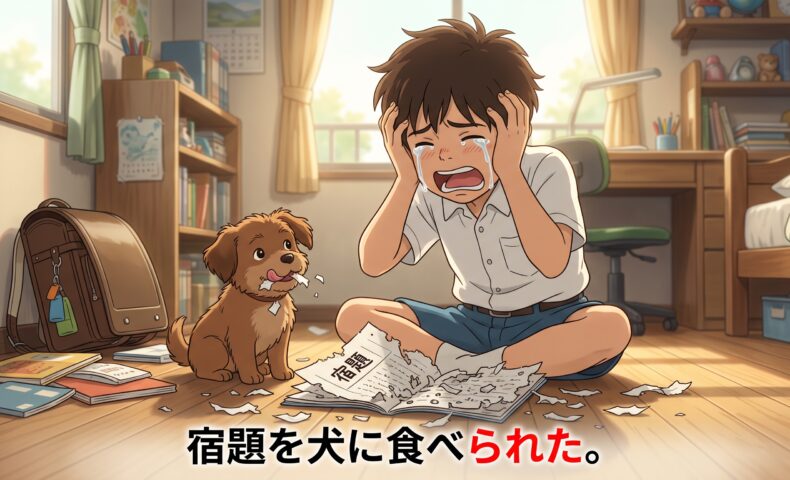
Like the passive form, the passive form of inconvenience is used to describe that “A” is being done by “B”, but with the connotation that what happened was unpleasant. In this form “A” is followed by the object particle を (wo), and “B” is followed by the particle に (ni). This form can often be translated without having the passive form in the English translation.
日本語 / にほんご / Japanese
(1)宿題を犬に食べられた / 食べられました。
(2)勝は泥棒に自転車を盗まれた / 盗まれました。
(3)私は赤ちゃんにブラウスを汚された / 汚されました。
(4)私は友達に恋人を取られた / 取られました。
(5)娘は隣の子供に人形を壊された / 壊されました。
ことばと表現 / Words & Expressions
– 泥棒【どろぼう\ /Dorobō/】thief, burglar
– 自転車【じてんしゃ ̄ /Jitensha/】bicycle
– 盗む【ぬすむ\ /Nusumu/】to steal
– 赤ちゃん【あかちゃん\ /Akachan/】baby
– ブラウス【ブラウス ̄ /Burausu/】blouse
– 汚す【よごす\ /Yogosu/】to dirty, to stain
– 恋人【こいびと\ /Koibito/】lover, boyfriend, girlfriend
– 取る【とる\ /Toru/】to take
– 隣【となり\ /Tonari/】next door, neighbor
– 人形【にんぎょう\ /Ningyō/】doll
– 壊す【こわす\ /Kowasu/】to break, to destroy
英語 / えいご / English
(1)The dog ate my homework.
(2)Masaru had his bicycle stolen by a thief.
(3)I had my blouse soiled by a baby.
(4)I had my lover stolen by a friend.
(5)My daughter had her doll broken by the neighbor’s child.
ひらがな / Hiragana
(1)しゅくだいを いぬに たべられた / たべられました。
(2)まさるは どろぼうに じてんしゃを ぬすまれた / ぬすまれました。
(3)わたしは あかちゃんに ぶらうすを よごされた / よごされました。
(4)わたしは ともだちに こいびとを とられた / とられました。
(5)むすめは となりの こどもに にんぎょうを こわされた / こわされました。
ローマ字 / Roman letters
(1) Shukudai o inu ni tabe rareta/ tabe raremashita.
(2) Shō wa dorobō ni jitensha o nusuma reta/ nusuma remashita.
(3) Watashi wa akachan ni burausu o yogosa reta/ yogosa remashita.
(4) Watashi wa tomodachi ni koibito o torareta/ tora remashita.
(5) Musume wa tonari no kodomo ni ningyō o kowasareta/ kowasa remashita.





No comments yet.